
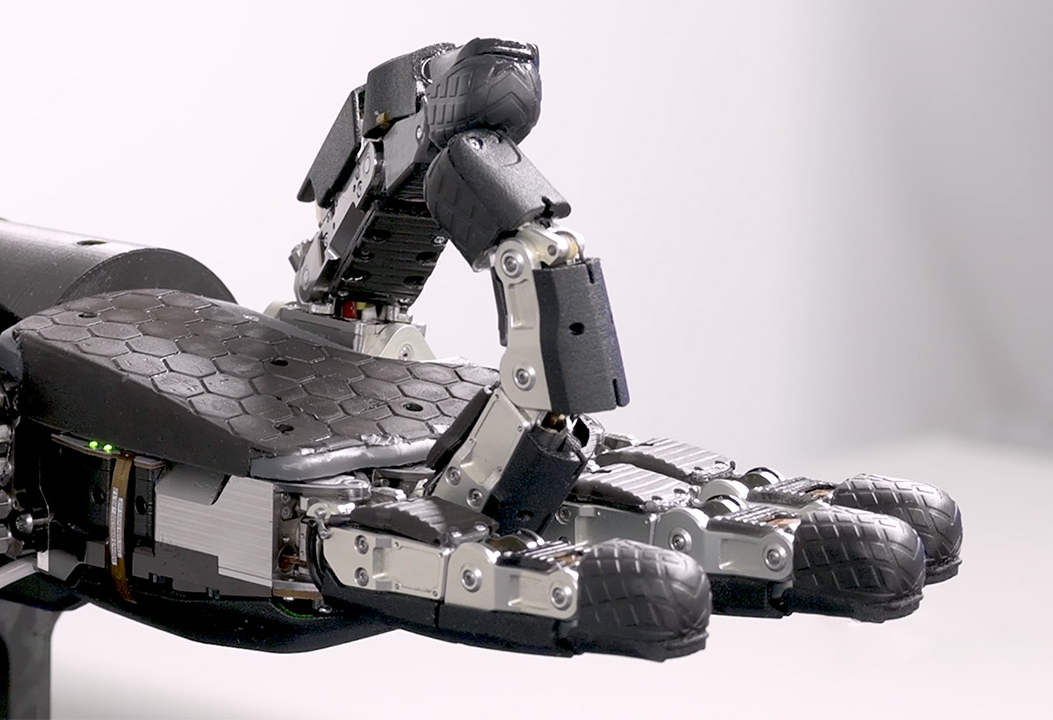
Sanctuary’s humanoid hands are among the most advanced in the world. I have previously worked on hand designs which use actuators embedded within the hand, and on tendon-driven hands with actuators in the forearm and I’ve witnessed some of the drawbacks of both designs.
The space constraints of squishing actuators into the hand mean that these designs often fall short of human performance in terms of power output, number of degrees of freedom and space for compliant flesh. On the other hand tendons wear out and have high, force-dependent friction.
Sanctuary’s approach of using hydraulic fluid to pass mechanical power across the moving wrist is interesting to me. Unlike tendons, fluid can be routed around tight corners without introducing a ton of friction, and has the potential to provide smooth, predictable motion with long lifetime. The smoothness and reliability of hydraulic vs. cable bicycle brakes is an example of this.
Pictured is Sanctuary’s current generation of hand, which is not my design. Instead I worked on ideas for the upcoming generation of hands, including a simplified thumb, novel wrist and finger mechanisms, a data-gathering device and a self-contained hand/wrist/forearm with all actuation in the forearm.

Images and video courtesy of Sanctuary AI